INTERVIEW WITH THE AUTHOR
lloyd@rjlloydwriter.com
Discover R.J. Lloyd and how he came to write Burning Secret in this extract from his interview with the Coffee Pot Book Club.
What was the most challenging part of the book to write about?
The most challenging aspect was capturing the main character's inner thoughts and tormented emotions. Despite these challenges, I was committed to bringing these feelings to life. While describing the objective world of sights and sounds can be tricky, conveying the deep emotions and heartache that are often hidden—especially when there are no overt behaviours—can be even more challenging. This is compounded by the writer's rule of "show, don't tell."
In Burning Secret, the main character leads a double life, burdened by guilt that torments him. Finding the right words to express his feelings as he grapples with his dilemma was not always easy. Nevertheless, these emotions are crucial for understanding his motives and actions.
What do I hope to achieve with the publication of my book?
At the very least, I want to inspire others to explore their family history and ancestry. Tracing one's roots has never been more popular or accessible. Who knows—these lost relatives might turn out to be far more intriguing or extraordinary than one could ever imagine. Sometimes, fact can be stranger than fiction.
Throughout my professional life, I've written evidence and reports for courts, statutory bodies and governments, where I quickly learned if my writing was effective. In contrast, knowing whether my novel and storytelling have merit is much more personal, as it ultimately relies on readers' reviews, recommendations, and sales.
What do you enjoy most about writing?
Gardening is one of my great passions. There's nothing quite like the joy of seeing flowers in full blossom on a warm summer afternoon, or watching vegetables thrive, ready to be harvested for the table. However, gardening also comes with its disappointments; not everything I plant and nurture will grow, survive the pests or be good enough to be judged at a local show.
Writing is similar in many ways. It isn't always enjoyable; sometimes it can be frustrating, tedious, and complex, especially when ideas fail to gain traction or when the words struggle to form coherent sentences. Yet, like gardening, writing is a creative process. You have the power to express your views and share your experiences and thoughts with others. Just as with any public speaking, not everyone will enjoy or agree with what you have to say, but at least you've expressed it.
No two gardens are the same, which is also true for authors and their books. Despite the differences, the pride and joy in creating something is a shared experience. The process of crafting a story, much like tending to a garden, brings immense pleasure and satisfaction.
How have you found your journey to publication?
The idea for Burning Secret emerged from a conversation in 2012 with my two dear American cousins, Susan and Kimberley. They encouraged me to share the extraordinary story of our common ancestor.
After reading an inspirational article by bestselling self-published author Paige Weaver (Promise Me Darkness) and learning that over one million books are published in the United States each year—two-thirds of which are self-published—I recognised a clear path forward. Matador Publishing became the obvious choice for me.
If you could give one piece of advice to your younger self, what would it be?
I'm going to sidestep this question. There's never just one piece of advice to give, and life is filled with too many what-ifs. However, one significant regret I have is not asking my parents about their lives and the history they experienced, including two World Wars, the Great Depression, rationing, the Roaring Twenties, and the Swinging Sixties. They never discussed any of it, and now it's too late.
What do you think makes a good story?
This is the million-dollar question. Many creative writing courses outline the key elements of a compelling narrative. Some argue that there are three essential components, while others list ten: structure, character, plot, tension, and more. Personally, I agree with W. Somerset Maugham, "There are three rules for writing a novel, Unfortunately, no one knows what they are."
More seriously, a story that captivates and holds my interest must be authentic, relevant, and resonate with my experiences and imagination. This largely depends on the storytelling and the flow of the language. I'm quite impatient, so a plot must move quickly to keep me turning the pages. I like a main character I can root for, even if they have some flaws. I appreciate a book that makes me think long after I've finished reading it.
Do you have any tips for aspiring authors?
Tell your story in your own voice, write from the heart, and keep pushing forward, despite the naysayers - of which there will be many. Writing can sometimes feel like a slog, but it's important to persevere. If you plan to publish, invest in a good book cover and quality production. The money spent on editing and proofreading is never wasted.
There's little point in publishing if no one reads your work, so give it your best shot with marketing. These days, that means social media. Marketing isn't just important; it's crucial in today's publishing landscape.
It can be tough, and most writers I meet wince at the thought of having to talk about and sell their cherished work. However, the sad truth is that no one else is going to do it for you, not even in traditional publishing. That said, it doesn't mean that the process can't be enjoyable.
Do you have a specific writing routine, and where do you prefer to write?
I wish I could say that I write from my veranda overlooking the tropical Caribbean Sea, like Fleming at Goldeneye or Hemingway at his Lookout Farm in Cuba, but that's not the case. I actually write from a small home office.
I do however enjoy having a routine. My background has instilled in me the importance of planning and scheduling. Most of my productive writing occurs between 8 a.m. and noon, although that's not when I do my best thinking. Instead, my best ideas come during the afternoons while I'm pottering in the garden shed or working in the allotment. However, the moments of clarity, when my ideas come together, usually strike me as I'm about to fall asleep. From bitter experience, I've learned that I need to wake myself up to jot down my thoughts, because by morning, every recollection will have vanished.
What are your upcoming writing projects?
I'm currently working on a couple of projects. The first is about another of my close ancestors, Frederick Henry Seddon, who was hanged for murder at HMP Pentonville in 1912. While his story has been told many times before, it has never, to my knowledge, been shared from the family's perspective. The other project involves a recently discovered family connection to two brothers, Peter and Veniamin Timkov, from the smal Russian village of Mukhouderovka, where they were executed by Stalin's secret police.
Are there any final thoughts you'd like to share?
When first starting to write, it can be challenging to see yourself as an author. However, social media like Twitter and Facebook have democratised writing, allowing countless aspiring authors to find their voices. Give it a go. Start writing and just keep going.
I have learned so much from my experience with writing and the publishing process. In the future, I will be much better prepared, having considered the title and book cover well before writing the opening paragraph.
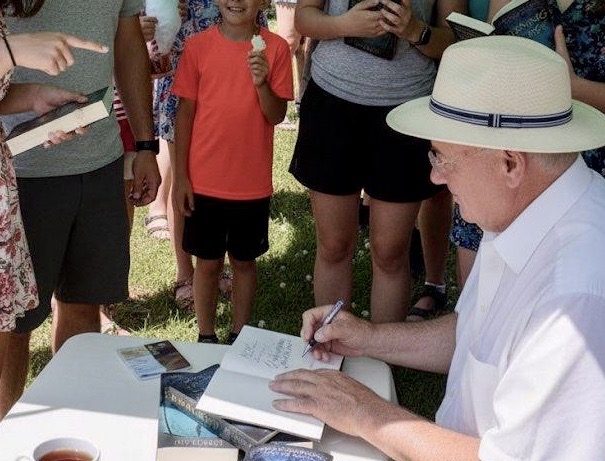
Experience the opportunity to meet Roger in Bristol, UK. He is available for engaging book signings, lively discussions at book clubs, and captivating appearances at local bookshops. Don’t miss your chance to obtain a personalised, signed copy of his work!
lloyd@rjlloydwriter.com